

Not every revolution starts with a sword. Some start with a whisper, a borrowed book, and a bar tab no one questions.
In the Scarred Realms, heroism is a luxury most can’t afford. The Cloak understands this better than anyone. They are not knights in gleaming armor. They are tavern keepers, librarians, slum-raised soldiers, and criminals who decided the city was worth more than their next score.
If you’re expecting a story about chosen ones and glorious last stands, you’re in the wrong place.
What The Cloak Actually Is
On the surface, The Cloak doesn’t exist. “Appears as a loose, quiet collection of ordinary working-class citizens, tavern regulars, library patrons, and basic forest traders maintaining their normal daily routines to completely evade municipal suspicion.” They appear to be ordinary working-class citizens: regulars at the local inn, patrons browsing the library stacks, forest traders keeping to their routes. This is by design. Their strength is invisibility. A resistance that looks like the population it protects is a resistance that cannot be easily rooted out.
Their official classification is “Underground Insurgency / Strategic Civil Resistance Cells”-a mouthful that essentially means they operate in small, specialized units with minimal cross-contact, reducing the damage of any single capture or betrayal.
The People Behind the Myth
Every resistance needs a face, but The Cloak prefers several-none of them particularly heroic.
Savier Starheel, the Innkeeper Commander, runs the operation from his tavern. Co-leader whose local tavern acts as the central hub for identifying and vetting sympathetic citizens. He provides the quiet confidence and ground-level leadership required to unite the local militia and ultimately assume total operational command of the city. He doesn’t lead from a throne; he leads from behind a bar, pouring drinks for guards he hopes to turn and refugees he needs to vet. His leadership style is quiet confidence and ground-level pragmatism. When the Council of Elders finally falls, it’s not because he seized power-it’s because everyone already knew he was the one actually keeping them alive.
Maggie, the Librarian Networker, serves as co-leader and intelligence chief. Co-leader and chief informational asset who utilizes her civic post to intercept regional data. She handles high-stakes extra-legal coordination, orchestrating the dispatch of “The Letter” to secure a fragile defensive alliance with High Cleric Cultro, a move that demonstrates The Cloak’s willingness to deal with morally complicated allies when survival is on the line.. Her position in the Society of Lost & Found gives her access to regional data most resistance movements could only dream of.
The operational core extends beyond these two. But will remain unnamed. For now.
How They Actually Operate
The Cloak’s tactical protocols reveal an organization that thinks in phases, not battles:
Intelligence & Exposure comes first-compiling dossiers on Council negligence while mapping monster movements. Compiling exhaustive dossiers detailing the Council’s defense negligence while mapping monster behavior and potential invasion routes.
Coalition Building follows quietly, engaging merchant guilds, religious circles, and professional associations to build civic consensus around survival rather than ideology.
Psychological Warfare frames the political transition strictly as an existential survival mechanism, building public confidence through transparent defense planning.
And The Courier Protocol deploys specialized, high-prowess independent operators to smuggle critical diplomatic communications across faction lines to recruit external assets.
Notice what’s missing? Assassination plots. Bombings. The dramatic violence that makes for good stories but terrible governance. The Cloak operates under strict constraints: no attacks on old leadership, no destruction of public property, no lethal force against city guards. All members are bound to a strict Peaceful Coup Strategy designed to prevent city infrastructure disruption. The core regulations strictly forbid launching personal attacks on old leadership, destroying public property, or utilizing lethal force against baseline city guards, ensuring a legitimate, consensus-driven transition framework that protects the city’s 15,000 residents. Their revolution is designed to leave the city standing when it’s over.
The Cost of Clean Hands
This approach is not without tension. The “Peaceful Coup Strategy” creates constant friction between pragmatism and desperation. The organization operates under extreme psychological pressure due to a tight, volatile timeline compressed to mere days by rising Frothbeast encounters. Constant paranoia regarding internal espionage or sudden city guard crackdowns creates operational friction. Additionally, logistical panic is triggered by the sudden arrival of the Lotro Army at Salt Bay, forcing members to rapidly debate whether to treat the foreign military force as a catastrophic occupation or a leverage tool to break the Council’s remaining resolve. When monster sightings compress your timeline to days, when refugees from Tu’us bring stories of Nosvartus raids, when monsters breach the inner defenses-patience becomes its own kind of violence.
The Crimson Coup Timeline:
From The Whispering Year, when anxiety first enabled cell formation, through The East Wall Breach on Day 17, when Savier stepped into the open, to The Bloodless Concession on Day 26-The Cloak moves like water, not fire.
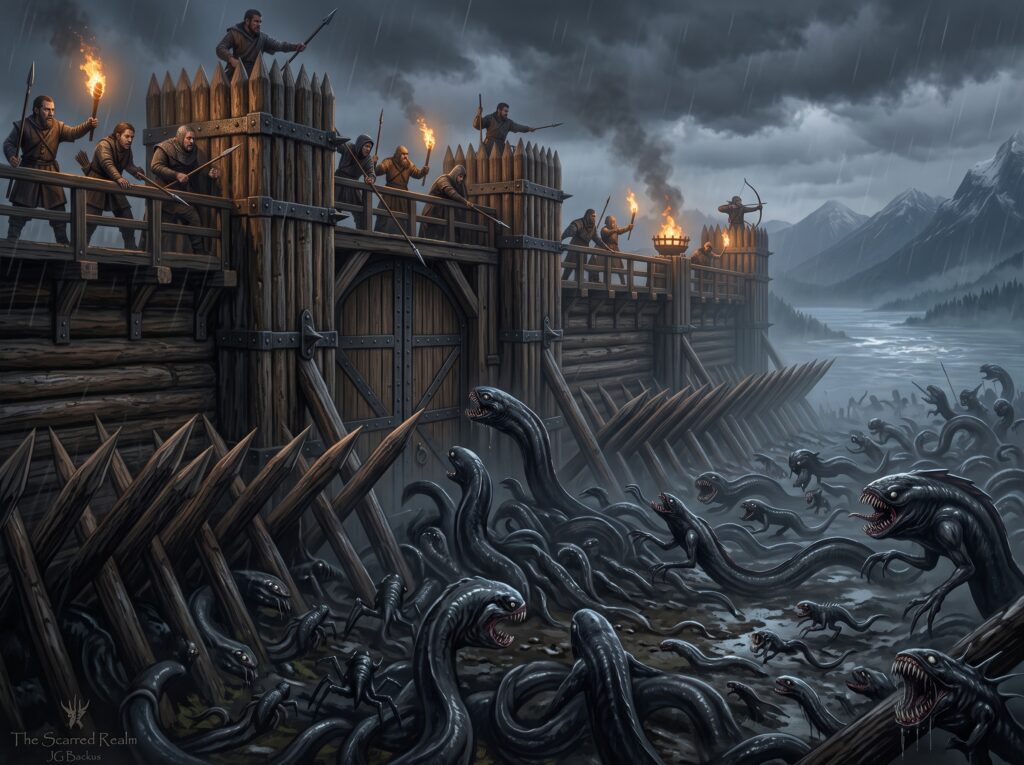
The Whispering Year: Increasing inland sightings of Frothbeasts spark deep public anxiety, enabling Savier and Maggie to establish clandestine resistance cells.
Day 17 (The East Wall Breach): A monster breach throws the government into absolute chaos. Savier Starheel steps into the open to coordinate defensive counter-measures, shifting the practical loyalty of the town militia away from the Elders.
Day 26 (The Bloodless Concession): Facing overwhelming public unity and the force of Savier’s will, the Council completely capitulates. Power is gracefully transferred to Savier and The Resistance, achieving a completely bloodless transition of government.
Why This Matters for Yara
Yara Whitlock operates in the gaps between these structures. She’s not a member of The Cloak-she’s a tool they deploy, a courier they trust because she has no institutional loyalty to betray. This makes her invaluable and untouchable, exactly the kind of asset a resistance that rejects traditional heroism would cultivate.
The Cloak doesn’t want heroes because heroes draw attention. Heroes make speeches. Heroes die conspicuously and leave movements without leadership.
What The Cloak wants-what it needs-are people willing to do necessary work without recognition, to survive without glory, to build something better without tearing everything down first.
In a world of monsters and collapsing light, that’s a revolution worth understanding.


Leave a Reply